Sony's Pellicle Cameras
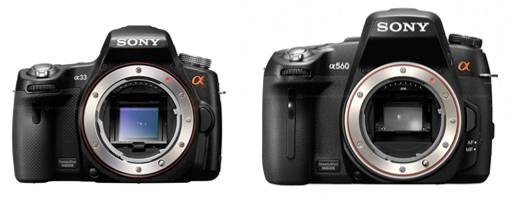
I took two photos from dpreview and scaled them so their lens mounts matched and here's the result. The a33 is markedly smaller than the a560, despite sharing the same sensor and image-processing pipeline (and being announced on the same day) so this is the immediate size-saving Sony obtained by ditching the conventional SLR mirror. That's pretty amazing.
Note that the new "conventional" DSLRs from Sony offer better continuous shooting (7fps with an optical viewfinder) but lack the focus-while-filming video (they still offer 1080p). If you recall, Sony's "conventional" DSLRs are already pretty radical, having a bunch of wacky design tradeoffs (a smaller, dimmer optical viewfinder) in exchange for faster phase-change autofocus in live view. I'd have liked to see more differentiation between the new pellicle cameras (which I see as compromising still shooting in favor of video) and the "conventional" DSLRs, but perhaps we'll be seeing a refresh of the a850 along those lines (and, after all, at $1950 the existing a850 is a serious bargain, assuming you're willing to hunt for second-hand lenses or wait and hope for Sony to release more).
Even More
Interesting criticism of the a55 (et al) here, mostly along the lines that video capabilities (1080i, low bitrate, and no manual controls) in the new cameras is seriously (and intentionally) crippled. Steadishot makes the camera overheat after 9 minutes. The AF only works when the aperture is wide-open, video bitrates are no better than compacts. I have to say I find interlaced HD video to be actively offensive (it's a holdover from analog and has no place in a modern pipeline).And more technical criticisms here, along the lines that marketing futzed with the specs, the onboard computer hardware is laggy in general and specifically the way the camera seizes up after shooting (if image review is switched on) is a major bummer. These are finicky, but not minor criticisms, since one of the two main reasons for using DSLRs over compacts is handling.
There's also some discussion as to "ghosting" caused by internal reflections in the mirror (which are unavoidable). This kind of thing could be post-processed out of the image (in-camera) since the effect is very consistent but it's another drawback of the fundamental design. (And it's quite noticeable in some of the examples in the thread.)