ForeSight Resurrection
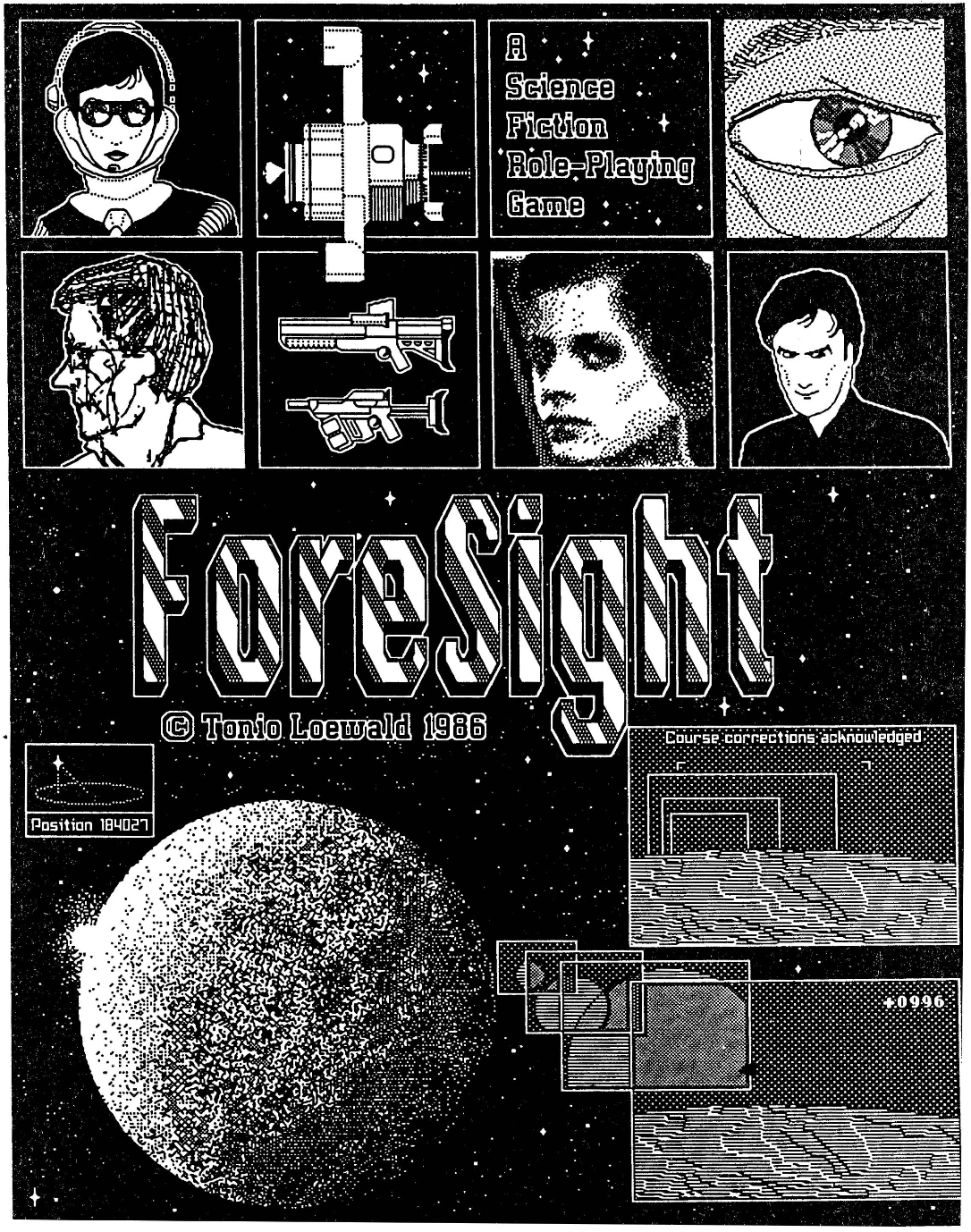
ForeSight—the role-playing game system—was published in 1986, when I should have been doing my "honours" year in Mathematics. Instead, I had become obsessed with creating the perfect role-playing game system.
I hadn't set out to design my own game at all (although I was very much interested in game design). I had in fact been frustrated by the fact that the only half-way decent SF RPG on the market—SPI's UNIVERSE—was very hard to find on store shelves, and had no realt background material.
So, overy my Summer vacation in 1983-4 I wrote a 300 page book—"The GameMaster's Guide to UNIVERSE"— as a kind of encyclopedic sourcebook for that game and asked my parents (who were on sabbatical in New York) to look up SPI and find out if they had any interest.
What I found out was the SPI was out of business, which also explained why it was getting so hard to find their games.
So, now I had a 300 page sourcebook for a game that wasn't being published.
Origins
The first version of ForeSight was basically a bunch of tables listing skills, fields, vehicles, and so on, along with "and just use the James Bond 007 resolution system". I then replaced that with its underlying math (which could be inferred from the tables in 007) and I had a highly workable game system, but one that had some of the more glaring problems in 007 baked in.
It's probably importsnt to understand just what was so great about the 007 rules. The rules were basically you have an ease factor (5 for typical tasks) and an ability score (e.g. 10 for poorly skilled, 25 for expert). Your percentage chance of success is the product, so a goon with Firearms 10 shooting at a human size target at shortish range (EF 5) has a 50/50 chance of hitting them.
Add in a bunch of very reasonable situational ease factor modifiers, e.g. -2 to hit someone behind partial cover, and you've already got a far more flexible game system than RuneQuest / GURPS / Champions.
Beyond success/failure, 007 gave every task a qualitative outcome. Instead of say "success", "failure", and—perhaps—"criticals" it gave a Quality Rating that ranged from the best (QR1) to a bare success (QR4). ForeSight added QRs for failure (QR7) and fumble (QR10). Quality Ratings could easily be converted into dramatic outcomes. QR1s were faster, more complete, did more damage, or whatever. QR4s were slower, noisier, less complate, did less damage.
One rule made everything work, and work well.
With ForeSight in the form of a dozen typed sheets of tables plus a character sheet and a page or two of rules, I ran a tournament using these rules and it went very well. (The overall story and ideas were eventually repackaged as Solo on Simiolus.) I also ran a campaign loosely inspired by Jack Vance's Tschai (a.k.a. Planet of Adventure) series.
ForeSight, 1986
I had learned as much as I could about SPI's game design and development process and wanted ForeSight to be at least as rigorously put together as SPI said its games were.
(I interviewed Jim Dunnigan a few years ago by email and discovered the truth was somewhat less ideal.)
As I understood it, a properly game should be:
- Designed and Developed
- Tested
- Revised and the preceding steps repeated as necessary.
- Blind Tested (i.e. tested by people with no previous background)
- Revised and the preceding steps repeated as necessary.
- Published
This was SPI's purported process and I stuck to it. Thanks to a friend-of-a-friend with access to an Australian Government print shop we were able to produce multiple copies of each revision in bound form. The final published version of the game had a small number of errors found and identified within a month of printing. The errata was included with the softcover edition, and a copy provided to the owners of the hardcover.
ForeScene: The Flawed Utopia, 1987
The reason I developed ForeSight in the first place was to replace SPI's UNIVERSE as the vehicle for the GameMaster's Guide I had written. But since I no longer had to be compatible with the sillier aspects of UNIVERSE, I spent a lot of time revising it into what I considered a solid hard science fiction setting.
This was then published in 1987, and included rules for EcoSystem Generation, Robots, Implants (inspired not just by cyberpunk novels but much earlier works such as Jack Vance's The Languages of Pao.
HindSight and the Age of Reason, 1987
ForeSight was always intended to be—like GURPS—"generic", and HindSight was intended to cover historic, present, and fantasy genres.
The systems for Magic and Divinity were, in my opinion, inspired, but the Magic rules were too complex in practice. (Not as bad as Chivalry & Sorcery…)
On one memorable occasion a group of playtesters were hanging out in our college kitchen (for Americans, "college" means "dorm") and a passing D&D player asked what we were doing. When they heard about our supposedly all-singing-and-dancing magic system they asked "OK, can you do Daern's Instant Fortress" (an adamantine block that when placed on the ground will, with a touch and a command word, expand into a fortified tower with a basement, and can be returned to pocket size on a different word—it's a direct ripoff of the "expandable egg" in Jack Vance's The Dying Earth).
Anyway, each person at the table (there were four, if I recall) quickly came up with a different method of making something like Daern's Instant Fortress with the HindSight Magic rules in a couple of minutes. Without fudging.
As for Divinity, it was inspired by the RuneQuest rules for divine intervention, but instead of "Rune Priests" and "Rune Lords" there was the distincition between priests who ministered to the faithful, and avatars, who embodied the deity, and also the concept of piety factor.
Mystic Disciplines were nice, but much better rules were later developed for them as the Ch’i rules for the tournament module The Fortune Cookie Monster.
ForeSight Enhanced, 1989
ForeSight Enhanced was something that made sense to me but not to anyone else. It was, in essence, a rewrite of the bits of ForeSight that I thought needed rewriting, and assumed you just used the old rules as appropriate everywhere else.
The correct way to do this kind of thing, commercially, is to revise everything and sell it all to your existing customers over again.
Anyway, the point was to address flaws in the character creation and representation rules (while also adding a few new flaws), slightly improve resolution, and address a problem in the combat rules with the concept of initiative (which is stupid), and clean up any inconsistencies that had crept in with ForeSight and HindSight covering so much ground.
The key good points of ForeSight Enhanced were:
- Randomness removed from character creation
- Building characters from Background Factors both improved balance and sketched out back story
- Simplfied skill system
- Changed high skill scores into 20+n where n become an ease factor modifier that made highly skilled people better in "the right way"
- Vastly improved the handling of pre-emption edge cases in combat (i.e. situations where who goes first really matters)
If you want an example of the last case, consider a hostage situation with a sniper. In ForeSight (1986) a sniper knows exactly when they can safely take out the hostage taker (with, say, 98% confidence). In ForeSight Enhanced it comes down to maybe 50-80%.
The key bad points of ForeSight Enhanced were:
- You now had to juggle more rule-books
- Fields of Knowledge were unnecessarily turned into a quagmire
And the main debatable point was:
- Combat felt less predictable, which meant people who wanted it to be a pure "wargame" didn't like it as much
Personally, I think violence should be horrible and unpredictable. And expecting it to be horrible and unpredictable creates better role-play.
To be continued…
Downloads
ForeSight (and related works through 2004) by Tonio Loewald is licensed under CC BY 4.0
